


Have you ever had that magical moment in a party game—that split second where you and a friend finish each other’s sentences or guess the same bizarre charade? It’s a feeling of being perfectly in sync, and it’s often the highlight of the night. Now, what if an entire game was built around creating that exact moment, over and over again? Check out neuquafootball.com to know more
This is the simple genius behind the medium card game. Imagine you have the word “Tropic” and your partner has “Juice.” Your shared mission is to secretly think of a single word that connects them. You both count down and say your word out loud. If you both land on “Orange,” you’ve successfully read each other’s minds and scored. It’s a game less about complex rules and more about the fun of understanding how your friends think.
Forget about thick rulebooks. Learning how to play the card game called medium genuinely takes less than two minutes. The real joy comes not from winning, but from the hilarious debates when you don’t match (“Why would ‘Radio’ connect ‘Ham’ and ‘Star’?!”) and the triumphant high-fives when you do. It’s one of those rare card games built for laughter and connection, not just collecting points.
What “Medium” Actually Means in This Card Game
Unlike most card games where you match numbers or suits, this game is all about the creative connections between words. The challenge is to find a “Medium”—the game’s term for a single word that connects two different cards. It’s less about the luck of the draw and more about the clever spark in your own mind.
For example, imagine one card on the table says NIGHT and another says CHEESE. Your brain might immediately jump to the word MOON, since we talk about the “man in the moon” and a popular myth says the moon is made of cheese. In that moment, MOON is the Medium you’ve discovered. It’s that simple “aha!” moment that makes the game so satisfying.
Every round is a new puzzle, with players racing to find these links. Your entire goal is to be the first person to spot a valid connection between the cards everyone can see.
Your 3-Step Guide to Setting Up the Medium Game
Getting started is refreshingly simple. This game is designed for four players, split into two teams of two. The most important rule for the medium game setup is where you sit: make sure you and your partner are directly across from each other at the table. This keeps the teams clear and makes the “mind-melding” we talked about earlier even more fun.
Once your teams are ready, you’re just moments away from playing. Here is your entire setup:
- Form Teams: Pair up and sit directly across the table from your partner.
- Deal the Cards: Give each of the four players a hand of six cards.
- Prepare the Points: Place all the scoring tokens in a pile where everyone can reach them.
With everything in place, you’re ready to attempt a “Mind Meld.”
A Step-by-Step Guide to Your First “Mind Meld”
This is where the real fun begins, putting your team’s psychic connection to the test. To start a round, you and your partner will secretly look at your own hands of six cards. Without saying a word to each other, you will each choose one card and play it face-up on the table for everyone to see. The challenge is that you have no idea what word your partner is about to play, which makes the next step an exciting puzzle.
With two words now visible—one from you, one from your partner—your team’s goal is to find a single word that connects them. For example, if your card says “Doctor” and your partner’s card says “Apple,” you both might think of the word “Worm,” “Health,” or even “Core.” You have to silently guess which connecting word your partner is most likely thinking of, hoping your minds are on the same wavelength.
Once you and your partner feel ready, you’ll begin a countdown together: “One… two… three!” On the count of three, you must both say your connecting word out loud at the exact same time. This simultaneous reveal is the heart of the game. The brief moment of suspense before you both speak is what makes every round so thrilling, whether you’ve played once or a hundred times.
If you both shout the same word—”Health!”—then congratulations, you have achieved a “Mind Meld” and scored for your team. But what if you say “Health” and your partner says “Worm”? Don’t worry, you still have a chance.
How Scoring Works (And What to Do if You Don’t Match)
Successfully matching on the first try is the ultimate goal, and the game rewards you handsomely for it. When you and your partner both shout out the same word, your team earns the highest-value scoring token—a significant step toward victory. This immediate success feels fantastic, but the real genius of the game is how it handles those moments when your minds aren’t quite in sync.
So, what happens if you said “Health” and your partner said “Worm”? You don’t lose the round! Instead, those two words become your new set of clues. Now, you and your partner must silently think of a new word that connects “Health” and “Worm.” This “second chance” mechanic is incredibly forgiving and often leads to some of the funniest moments in the game as you try to bridge an even wider conceptual gap.
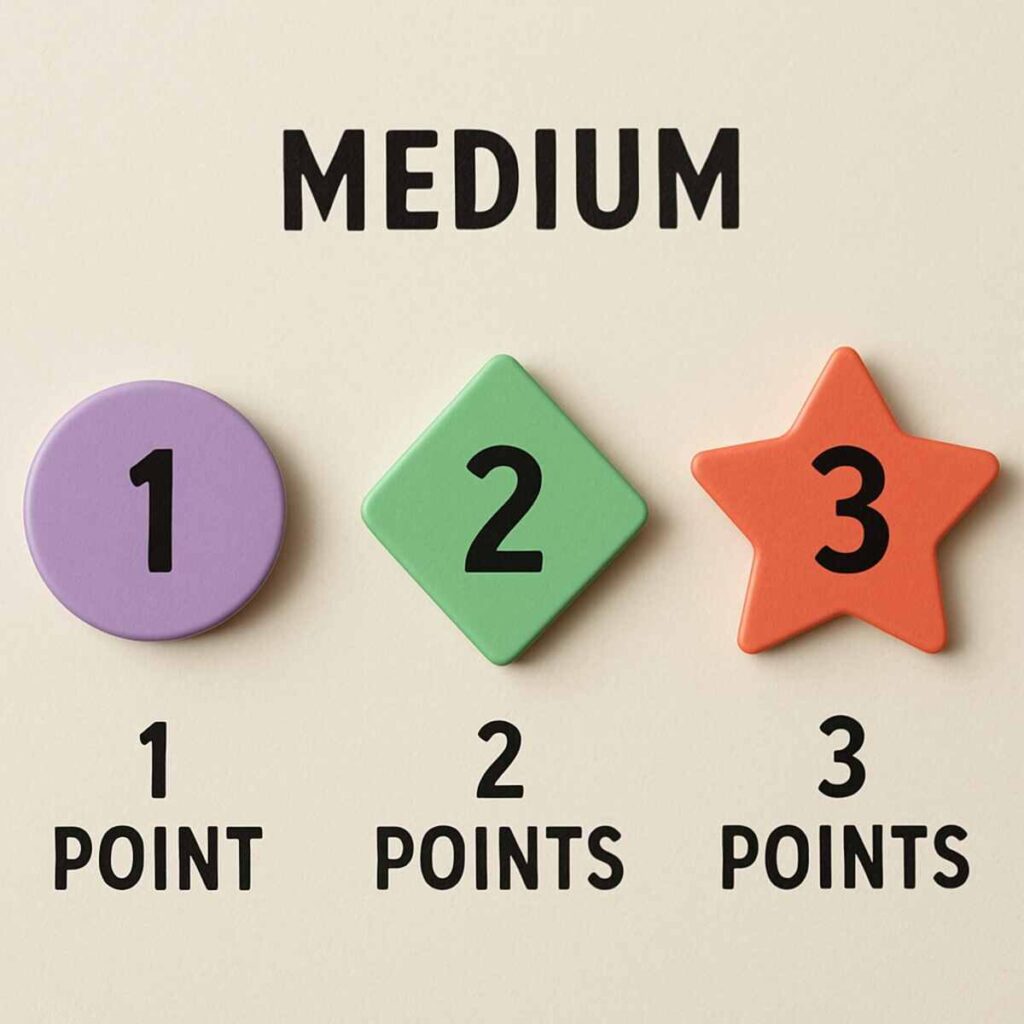
Your reward for matching depends on how many attempts it takes. As you can see from the different scoring tokens, a first-try match earns your team the most points. A successful second attempt earns a medium-value token. If you miss again, you get one final, third-chance attempt using the newest mismatched words, which is worth the lowest-value token. After three tries, the round is over, and you move on.
This tiered system keeps the game exciting because there’s always a chance to salvage points, but it also creates a strong incentive to really tune into your partner’s way of thinking.
3 Simple Strategies to Win at Medium (Without Being a Psychic)
While a lucky guess feels great, consistent wins in Medium come from a few simple mindset shifts, not psychic powers. Success is less about pulling a brilliant, obscure word out of thin air and more about building a reliable bridge to your partner’s brain.
Your first instinct should be to fight the urge to be overly clever. If your clue words are “Ocean” and “Sand,” your brain might jump to a poetic word like “Shoreline.” But what’s the most common, almost boring word that connects them? “Beach.” The most obvious connection is almost always the one your partner is thinking of, too. Prioritize simplicity over style to secure those high-value, first-try matches.
Every round, successful or not, gives you valuable information. Pay close attention to your partner’s logic. Did they connect “Apple” and “Health” by thinking of “Doctor”? Or did they go with “Fruit”? Remembering these patterns helps you build a unique language together. The more you play, the better you’ll get at predicting their specific brand of logic, turning past misses into future victories.
Finally, the most powerful strategy is to stop asking, “What’s a good word for this?” and start asking, “What word would my partner say?” If you know your partner is a huge sci-fi fan and the clues are “Planet” and “Desert,” a word like “Tatooine” might be a risk worth taking with them, even if it’s not obvious to others. This focus on connection is what makes the game shine.
How to Play Medium with Any Number of People
So, what if it’s just you and one other person? You’re in luck. While the standard game is competitive, you can absolutely play Medium with 2 players as a purely cooperative challenge. Instead of trying to beat each other, you work together as a single team. The goal is simple: see how high a score you can achieve over a set number of rounds. It’s a fantastic way to practice building that mental connection without any pressure.
For larger gatherings with five or more people, the game transforms into a lively team-based party. Simply split into pairs (with one group of three if there’s an odd number). Instead of every individual taking a turn, each team takes a turn. Play proceeds clockwise around the table from team to team. For example, if you have three teams, Team A will take their turn, then Team B, and then Team C before it goes back to Team A. This keeps the game moving and ensures everyone stays involved.
Ultimately, the beauty of Medium is how it scales to fit your group. From a quiet, cooperative game for two on the couch to a boisterous competition between four different teams, the core of the game—finding that perfect connection—remains the same.
Avoid These 3 Common Mistakes That Cost You Points
Winning at Medium feels like you’ve performed a magic trick, but sometimes our own habits get in the way of reading our partner’s mind. If you find your connections are consistently missing the mark, you might be falling into one of a few common traps. Correcting them is the fastest way to improve your score.
The most frequent pitfall is getting either too personal or too clever with your clues. It’s tempting to use an obscure inside joke, but if your partner isn’t on that exact wavelength, the link is impossible to find. On the flip side, overthinking a word can lead you to a connection that is five steps removed from the obvious. Trust your first, most universal instinct. For “Ocean,” the word “Blue” is a far safer bet than a specific, complex answer like “Creature.”
Equally important is paying attention when a match doesn’t happen. When a pair reveals their mismatched words—say, “Sun” and “Star”—those words are now public knowledge. A common mistake is to ignore that information. Instead, treat it as a valuable clue. You now know what your partner was thinking, which helps you calibrate for the next attempt. You’ve learned something about their logic.
By keeping your clues accessible and your ears open, you’ll find your scores climbing and your “mind-melds” happening far more often.
Love Medium? Here’s What to Play Next
If you love the “mind-meld” moment in Medium, several other fantastic party card games capture that same spark of connection. Here are a few great games to try next:
- For more mind-melding: The Mind. You and your friends try to play numbered cards in ascending order—without saying a single word. It’s pure, silent intuition.
- For more clever word clues: Codenames. Give one-word clues to get your team to guess multiple words on the table, making you feel like a master spy.
- For cooperative word guessing: Just One. Everyone writes a secret clue for a guesser, but identical clues get canceled out, forcing you to think outside the box.
Each of these brilliant games builds on the skills you’ve started developing. They focus on connection over complexity, proving a great game night is less about complicated rules and more about understanding the people you’re playing with.
Your Turn to Play: Get Started with Medium Tonight
What once might have seemed intimidating on a store shelf is now revealed for what it is: a simple, clever game about connection. The rules quickly get out of the way, letting you and your friends focus on the best part—trying to read each other’s minds.
Want to feel that magic right now? Grab a friend and try this: each of you write five random nouns on slips of paper. Secretly choose one each, then try to find the Medium between your two words.
That spark of connection is the heart of this fun card game. The real victory isn’t just in the points; it’s in the shared laughter when you and a friend land on the exact same wavelength. You’re ready. Go have some fun.
