


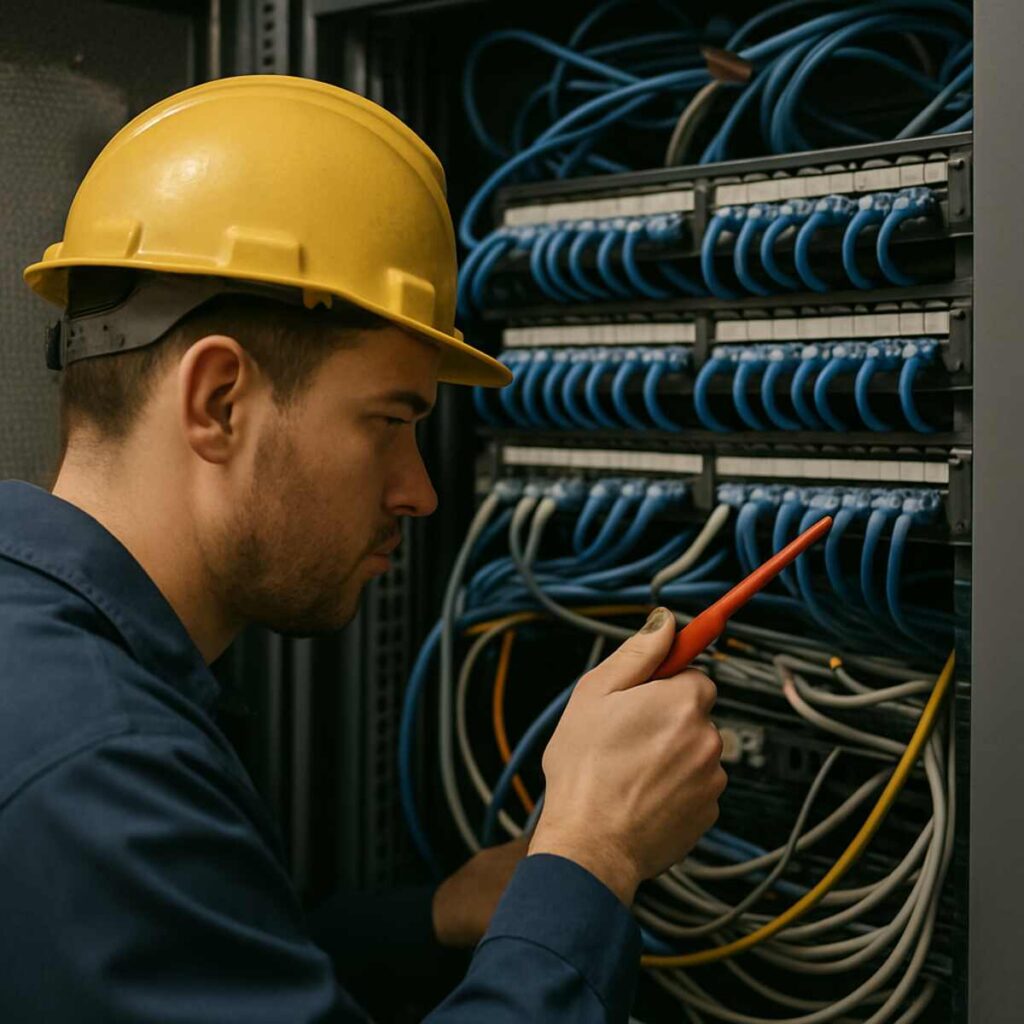
Have you ever wondered how the modern world stays so seamlessly connected? Behind the glowing screens, smart home hubs, lightning-fast internet connections, and sophisticated security networks lies an invisible web of wires and cables. The architects of this digital nervous system are highly skilled professionals known as low voltage electricians. The best guide to finding electrician Highlands Ranch CO.
As technology evolves at a breakneck pace, the demand for experts who can install, maintain, and troubleshoot these complex networks is skyrocketing. Whether it is bringing a historic building into the 21st century or wiring a cutting-edge smart hospital, the role of a low voltage electrician has never been more critical.
In this comprehensive guide, we will explore the ins and outs of this dynamic profession. We will dive deep into the career trajectory, essential skills, modern technologies, and the myriad of opportunities awaiting those who choose this path.
What is a Low Voltage Electrician?
A low voltage electrician is a specialized tradesperson who focuses on installing, maintaining, and repairing systems that operate on 50 volts (V) of electricity or less. Unlike traditional electrical workers who handle the high-voltage power lines that bring electricity into a building, low voltage technicians handle the infrastructure that makes modern communication, security, and automation possible.
Distinguishing the Roles
To truly understand the profession, it helps to compare it to other familiar roles in the industry:
- Residential Electrician: A traditional residential electrician primarily deals with high-voltage systems (typically 120V to 240V). They install the main breaker panels, wall outlets, lighting fixtures, and the heavy wiring (like Romex) that powers large appliances.
- Electrical Contractor: An electrical contractor is a business person or firm that employs electricians to design, install, and maintain electrical systems on a larger scale. While many contractors handle high-voltage projects, a growing number of modern electrical contractor firms now have dedicated low-voltage divisions to handle the surging demand for smart technologies.
- Low Voltage Electrician: This professional steps in after the high-voltage power is established. They deal with data cables (Cat5e, Cat6, Cat6a), fiber optics, coaxial cables, and speaker wires. Their work powers the “brains” of the building rather than the “muscle.”
Understanding the Voltage Divide
One of the foundational concepts in this trade is understanding the differences between line voltage and low voltage systems.
Line voltage (or high voltage) is the standard 120V power that comes from your wall outlet. It carries a significant risk of severe electric shock and fire if mishandled, requiring heavy insulation and strict conduit protections. Low voltage systems, on the other hand, operate at 50V or less (often 12V or 24V). While low voltage carries a significantly reduced risk of fatal shock, it is highly sensitive to interference, signal degradation, and data loss. Therefore, a low voltage technician must focus heavily on the quality of the connection, proper routing, and data integrity.
The Structured Cabling Technician Career Path
For those interested in technology and hands-on work, the structured cabling technician career path offers incredible upward mobility, job security, and excellent earning potential.
1. Entry-Level: The Apprentice or Helper
Most technicians start as apprentices or cable pullers. In this phase, the focus is on learning the physical demands of the job: running hundreds of feet of cable through ceilings, drilling pathways, and mastering the art of keeping cables organized. You will learn how to read basic blueprints and understand the safety protocols of a construction site.
2. Mid-Level: Lead Technician
After acquiring 2 to 4 years of experience, technicians often advance to a lead role. At this stage, you are no longer just pulling cable; you are terminating connections, testing lines, building out server racks, and troubleshooting complex issues. Lead technicians often supervise small teams of apprentices.
3. Senior Level: Project Manager or Systems Designer
Experienced technicians can move into project management, where they oversee large-scale commercial installations, manage budgets, and coordinate with other trades. Alternatively, some choose the design route, engineering the layout of complex audio-visual or data networks for new constructions.

Licensing and Certifications
A common question for newcomers is: what systems require a limited energy license?
Licensing requirements vary wildly by state and municipality. However, in many jurisdictions, working on systems that tie into life safety—such as fire alarms, access control, and specialized security systems—requires a state-issued Limited Energy License (often called a Class B or LEA license). Even if your state does not require a license for basic data cabling, acquiring one dramatically increases your marketability and allows you to work on highly regulated, lucrative commercial projects.
In addition to state licenses, industry certifications are highly prized. Certifications from BICSI (Building Industry Consulting Service International), such as the Installer 1, Installer 2, or the prestigious RCDD (Registered Communications Distribution Designer), are the gold standards in the industry.
Core Technologies Shaping the Industry
A low voltage electrician must be a jack-of-all-trades when it comes to technology. Below is a deep dive into the specific systems and technologies you will encounter daily.
1. Networking and Data Infrastructure
Data cabling is the bread and butter of the low voltage industry. Every office building, hospital, and modern home requires robust network wiring to support internet access, Wi-Fi access points, and internal communications.
A massive shift in this sector is the rise of Power over Ethernet (PoE). Understanding the advantages of Power over Ethernet technology is crucial. PoE allows a single ethernet cable (like a Cat6) to transmit both a data connection and electrical power to devices such as IP cameras, VoIP phones, and wireless access points. The advantages include:
- Cost Efficiency: Eliminates the need to hire a traditional electrician to install standard AC outlets near every camera or access point.
- Flexibility: Devices can be installed in hard-to-reach places (like high ceilings) without worrying about proximity to power lines.
- Reliability: Centralizing power allows the entire network of devices to be easily connected to a single Uninterruptible Power Supply (UPS), ensuring systems stay online during power outages.
2. Smart Home Automation
The residential sector has exploded with the advent of the Internet of Things (IoT). Today’s homeowners want everything from their lights and thermostats to their blinds and audio systems connected to a central hub.
Smart home automation system integration is a complex puzzle. A skilled low voltage electrician must understand how different protocols (like Zigbee, Z-Wave, Wi-Fi, and hardwired Ethernet) interact. They must integrate disparate systems—such as linking a home theater system to automated dimming lights and motorized shades—so they work flawlessly under a single user command.
A critical component of this is installing structured media enclosures for residential use. A structured media enclosure is essentially the “command center” of a smart home, usually recessed into a wall in a utility room or closet. Best practices for installation include:
- Thermal Management: Ensuring the enclosure has adequate ventilation, as multiple active switches, routers, and hubs generate significant heat.
- Future-Proofing: Leaving ample extra room in the panel for future technological upgrades.
- Cable Management: Neatly routing incoming ISP lines, coaxial cables, and Cat6 runs using velcro straps to avoid a tangled “spaghetti” mess that makes future troubleshooting impossible.
3. Commercial Audio/Video and Paging
In commercial environments, low voltage electricians are responsible for installing boardroom presentation systems, background music infrastructure, and public address setups.
A major consideration in large facilities (like warehouses, hospitals, or retail stores) is commercial paging system scalability. Older analog paging systems were notoriously difficult to expand. Today, technicians install IP-based paging systems that reside on the building’s data network. This allows for ultimate scalability; adding a new speaker is as simple as running a single Cat6 cable to a PoE speaker and assigning it an IP address. It also allows for distinct “zones” to be created via software, so an announcement can be targeted to a specific floor rather than the whole building.
Working with A/V also means dealing with interference. Fixing common audio visual interference issues is a frequent task. Interference often manifests as a hum in speakers or rolling lines on a video display. Common fixes include:
- Eliminating Ground Loops: Ensuring all A/V equipment is plugged into the same electrical ground to prevent voltage differences that cause audio hums.
- Cable Separation: Never running low voltage A/V cables parallel to high voltage power lines. If they must cross, they should do so at a 90-degree angle.
- Using Shielded Cables: In environments with high electromagnetic interference (EMI), utilizing shielded twisted pair (STP) cables to protect the signal integrity.
Security, Surveillance, and Life Safety
Security and life safety are heavily regulated and critical aspects of a low voltage electrician’s scope of work.
Surveillance Systems (CCTV)
While installing cameras in a new build is straightforward, retrofitting security cameras in existing buildings requires exceptional skill. Technicians must be adept at “fishing” wires through finished dry-wall, navigating historic building materials (like plaster and lathe), and finding creative pathways without damaging the aesthetics of the building. In scenarios where trenching a hard line to a remote parking lot pole is cost-prohibitive, technicians must implement wireless point-to-point bridges to beam the camera’s data back to the main building, seamlessly integrating wireless and hardwired technologies.
Fire Alarm Systems
Fire alarm installation is quite literally a matter of life and death. Technicians must strictly adhere to the National Fire Protection Association (NFPA) codes.
A common debate in modern installations is the use of wireless versus hardwired fire alarm systems.
- Hardwired Systems: These are the traditional standard. They are incredibly reliable and do not suffer from signal interference. However, installing them in existing, older buildings can be labor-intensive and expensive.
- Wireless Systems: Modern wireless commercial fire alarms have improved drastically. They are ideal for historic buildings where drilling is prohibited, or for rapid deployment. The tradeoff is maintenance; wireless systems require strict battery replacement schedules and careful site surveys to ensure robust signal strength across all smoke detectors and pull stations.
Tools, Testing, and Termination
To be successful, a low voltage electrician must be armed with the right tools and the knowledge of how to use them.
The Essential Toolkit
When asking what tools are essential for data wiring, the list goes far beyond a simple hammer and screwdriver. A professional toolkit includes:
- Snips (Electrician’s Scissors): For cleanly cutting copper wires.
- Punch Down Tool: Essential for terminating wires into keystone jacks and patch panels (typically using 110 or 66 blocks).
- Wire Strippers: Specialized for carefully removing the outer jacket of Cat5/Cat6 cables without nicking the delicate internal twisted pairs.
- RJ45 Crimper: Used for attaching modular connectors to the ends of ethernet cables.
- Fish Tape and Glow Rods: Crucial for pulling wire through tight conduits, drop ceilings, and insulated walls.
- Label Maker: A well-labeled network is the mark of a true professional.
Troubleshooting and Testing
Running the cable is only half the battle; proving it works is the other. Knowing how to test network cable continuity is a fundamental skill.
- Basic Wire Mapping: Using a basic tester, the technician checks that pins 1 through 8 on one end of the cable match pins 1 through 8 on the other end, ensuring no pairs are crossed or broken.
- Advanced Certification: For commercial data networks, clients often require a certification report. Technicians use advanced tools (like a Fluke network tester) to check for Near-End Crosstalk (NEXT), Return Loss, and cable length, ensuring the line can truly handle gigabit or 10-gigabit speeds.
Mastering Fiber Optics
As the demand for infinite bandwidth grows, fiber optics have moved from the street level to inside the building. Unlike copper, which transmits electrical pulses, fiber transmits light.
Performing a step-by-step fiber optic cable termination requires precision, patience, and a sterile working environment:
- Stripping: Using precision strippers to remove the outer jacket, Kevlar strength members, and the protective buffer coating to expose the bare glass fiber.
- Cleaning: Wiping the bare glass with lint-free wipes and 99% isopropyl alcohol to remove any oils or debris.
- Cleaving: Using a specialized high-precision cleaver to cut the glass fiber at a perfect 90-degree angle. (You cannot cut glass with scissors; it must be microscopically scored and snapped).
- Splicing/Termination: Either inserting the cleaved fiber into a mechanical connector with index-matching gel or using a fusion splicer (a machine that uses an electric arc to literally weld two microscopic pieces of glass together).
- Polishing and Testing: If doing hand-terminations, the end of the fiber is polished on microscopic grit paper. Finally, a Visual Fault Locator (a powerful red laser) or an OTDR is used to ensure light passes through perfectly.
Infrastructure Design and Code Compliance
A successful low voltage electrician doesn’t just know how to pull a wire; they know where and why.
Planning the Telecommunications Room
The heart of any commercial low voltage network is the server room. Proper telecommunications room layout and design (often referred to as the MDF – Main Distribution Frame, or IDF – Intermediate Distribution Frame) is vital.
- Space and Clearance: Racks must be positioned with enough front and rear clearance for technicians to work safely.
- Cable Pathways: Overhead ladder racks or sub-floor cable trays must be implemented to route massive bundles of wire neatly into the top or bottom of the server racks.
- Cooling and Power: While the low voltage tech doesn’t install the AC unit, they must design the rack layout to optimize airflow (hot aisle/cold aisle configuration) and coordinate with high-voltage electricians to ensure dedicated power receptacles are placed near the racks.
National Electrical Code (NEC) Compliance
Just because a wire won’t electrocute you doesn’t mean there are no rules. Strict adherence to building codes is mandatory, specifically National Electrical Code Article 725 compliance.
Article 725 covers Class 1, Class 2, and Class 3 remote-control, signaling, and power-limited circuits. Key takeaways for low voltage electricians include:
- Separation of Circuits: The code explicitly dictates that low voltage communication cables cannot share the same raceway, conduit, or junction box as high voltage power lines, as a fault in the high voltage line could energize the low voltage network, destroying equipment and causing fires.
- Plenum vs. Riser Ratings: Cables run in plenum spaces (areas used for environmental air circulation, like the space above a drop ceiling) must have a specific fire-retardant jacket (CMP rating). If a non-plenum cable burns, it releases highly toxic fumes which the HVAC system would instantly circulate throughout the building. Knowing these NEC codes prevents catastrophic liability.
The Future of the Low Voltage Industry
The career outlook for a low voltage electrician is exceptionally bright. As we move further into the era of the Smart Building, the lines between Information Technology (IT) and Operational Technology (OT) are blurring.
Soon, everything in a commercial building—from the HVAC system and the window tinting to the lighting and security—will reside on a single, unified PoE-powered IP network. The concept of “PoE Lighting,” where massive LED light fixtures are powered entirely by ethernet cables rather than traditional high-voltage wiring, is already disrupting the standard electrical industry.
Furthermore, the rollout of 5G infrastructure, the expansion of electric vehicle (EV) charging communication networks, and the integration of Artificial Intelligence into home security systems mean that the skills of a structured cabling technician will only become more valuable.
Conclusion
Becoming a low voltage electrician is more than just learning how to strip wires; it is about becoming an architect of modern connectivity. From understanding the nuanced differences between high and low voltage systems to mastering the precision of fiber optic terminations, the trade requires a blend of physical dexterity, technical intellect, and problem-solving skills.
Whether you are navigating the structured cabling technician career path toward becoming a project manager, mastering smart home automation system integration for luxury residences, or ensuring strict National Electrical Code Article 725 compliance on a massive commercial build, the opportunities are boundless.
If you are looking for a career that is hands-on, mentally stimulating, and completely future-proof, stepping into the world of low voltage electrical work might just be the smartest connection you will ever make.