


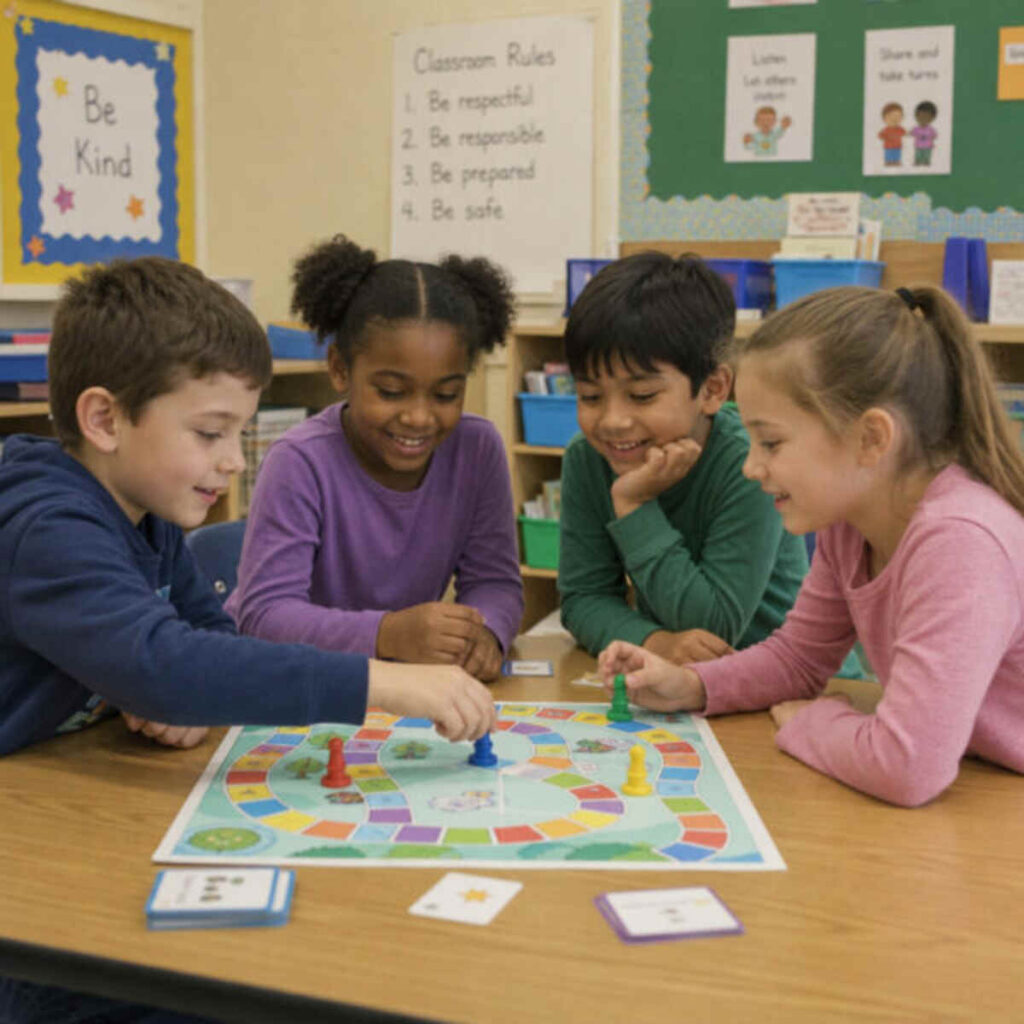
Primary game design is about creating playful learning experiences that help primary-aged children explore ideas, practise skills, and stay motivated long enough to make real progress. A well-designed primary game is not just a reward at the end of a lesson; it can become the lesson itself, giving children a reason to think, move, talk, test, fail, and try again. Whether you are a teacher, parent, tutor, or learning designer, the goal is to build games that feel fun to children while still serving a clear learning purpose. What do you consider about Pestoto.
What makes a primary game engaging for children?
A primary game becomes engaging when it gives children a clear goal, simple rules, meaningful choices, quick feedback, and a challenge that feels achievable but not automatic. Children need to understand what they are trying to do, why their actions matter, and how they can improve on the next turn. The best designs keep the cognitive load manageable, use familiar themes or concrete materials, and make success feel earned rather than random.
Engagement also depends on emotional safety. A child who feels embarrassed, rushed, or confused is less likely to participate fully, even if the game looks exciting from the outside. Good primary game design gives children multiple ways to contribute, celebrates effort as well as accuracy, and builds in low-pressure chances to recover from mistakes.
This matters because children at primary age are still developing attention, self-regulation, collaboration, confidence, and problem-solving habits. A game can support all of these, but only if its design respects how children actually learn. Fast visuals, noisy competition, or complicated point systems may create excitement, yet they do not automatically create understanding.
Play works best when it has a clear purpose
Play is powerful because it gives children a reason to act. Instead of being told to complete another worksheet, they might be rescuing a lost character, building a bridge, solving a mystery, collecting clues, or racing the clock as a team. The learning is still there, but it is wrapped in a situation that invites curiosity.
A purposeful primary game starts with one question: what should children understand, practise, or feel more confident doing by the end? If that answer is vague, the game will likely become vague too. “Make maths fun” is a worthy intention, but it is not a design target. “Help children practise adding two-digit numbers with regrouping” gives the game a direction.
Purpose also prevents games from becoming decorative. A pirate theme, colourful tokens, or digital badges can make an activity more appealing, but they are not enough on their own. The game mechanics must connect to the learning. If children are learning spelling patterns, then the key actions should involve hearing, building, sorting, or applying words. If they are learning cooperation, then the rules should require listening, turn-taking, shared planning, or group decision-making.
A useful way to check purpose is to remove the theme and ask whether the activity still teaches the target skill. If it does, the theme can enhance it. If it does not, the design may need more work.
The building blocks of strong primary game design
A strong primary game usually feels simple to play but thoughtful underneath. Children should not need a long explanation before they can begin. At the same time, the teacher or adult should be able to see how the game supports learning, behaviour, and progression.
Use these building blocks as a practical design checklist:
- A clear learning objective: Define the skill, concept, behaviour, or vocabulary the game should develop. Keep it narrow enough to observe.
- A child-friendly goal: Translate the learning objective into a playful mission, such as building a tower, collecting clues, reaching a finish line, solving a puzzle, or helping a character.
- Simple rules: Use only the rules needed to create the challenge. If children keep asking what to do next, the structure may be too complicated.
- Meaningful choices: Let children make decisions that affect the outcome, such as choosing a strategy, selecting a card, explaining an answer, or deciding how to help a teammate.
- Fast feedback: Children should quickly learn whether their action worked, partly worked, or needs a rethink.
- Balanced challenge: The game should not be so easy that children coast or so hard that they disengage.
- Opportunities to talk: Primary learning is often strengthened when children explain, predict, justify, compare, or negotiate.
- A fair ending: The game should finish in a way that feels satisfying, whether children win, improve a score, complete a mission, or reflect on what they learned.
These blocks are flexible. A five-minute phonics game, a playground teamwork challenge, and a digital problem-solving adventure can all use the same design principles. What changes is the format, not the need for clarity.
How do you design a primary game for different learners?
You design a primary game for different learners by making the core task accessible, then adding flexible levels of support and challenge. Children should be able to enter the game at a manageable point, understand what success looks like, and stretch themselves without feeling singled out. The strongest designs plan for variation from the beginning rather than treating support as an afterthought.
Differentiation does not always mean creating three separate versions of the same game. Often, it means designing adjustable parts. A word game might include easier and harder card sets. A maths game might let children choose numbers within a range. A science sorting game might begin with picture cards, then move toward written explanations. A storytelling game might allow children to draw, speak, write, or act out their response.
For younger children or those who need more structure, visual cues can make a big difference. Icons, colour coding, example turns, and physical objects help reduce memory pressure. For children who are ready for more challenge, extension rules can add depth without disrupting the whole group.
Practical ways to support mixed abilities
- Offer tiered materials: Use the same game structure with different card sets, number ranges, reading levels, or problem types.
- Use partner roles: One child might read the prompt while another builds, draws, calculates, or explains.
- Build in hints: Hint cards, example boards, sentence starters, or visual reminders let children seek support without stopping the game.
- Add optional challenges: Bonus tasks can invite deeper thinking for children who finish quickly.
- Allow multiple response modes: Children can show understanding through speech, drawing, movement, objects, writing, or digital interaction.
- Keep the win condition broad: Instead of rewarding only speed, reward accuracy, explanation, teamwork, improvement, or creative strategy.
The key is to make support feel normal. When every child has choices, tools, and possible pathways, no one is marked out as the child who needs the “easy” version. That creates a healthier atmosphere and usually improves participation.
Turning curriculum goals into playable challenges
The most effective primary game ideas often begin with a curriculum goal, then turn that goal into an action children can repeat with interest. Repetition matters because children need practice. The challenge is to make that practice feel purposeful rather than mechanical.
Start by identifying the learning behaviour you want to see. Do you want children to recall facts, classify objects, explain reasoning, compare ideas, plan a sequence, use vocabulary, listen carefully, or revise a strategy? Once you know the behaviour, you can choose a mechanic that naturally invites it.
For example, if the goal is vocabulary recall, matching and clue-giving mechanics work well. If the goal is reasoning, children might need to defend a choice or solve a mystery using evidence. If the goal is fluency, a short timed round can help, as long as it does not create anxiety or reward speed over understanding.
A simple design process
- Name the learning goal. Write it in one sentence. For example: children will identify odd and even numbers up to 100.
- Choose the game action. Decide what children will physically or mentally do. They might sort cards, move tokens, collect sets, or challenge a partner’s answer.
- Set the success condition. Make it clear how children progress. They might complete a path, fill a board, unlock a clue, or beat their own previous score.
- Add feedback. Decide how children will know if they are correct. Feedback might come from a peer, an answer key, a teacher, a self-checking card, or a game result.
- Plan support. Add examples, visuals, easier starting options, or partner roles.
- Playtest quickly. Try one round and watch where children pause, argue, rush, or lose focus.
- Refine the rules. Remove anything unnecessary and strengthen anything that helps learning.
This process works for both physical and digital design. A primary game does not need expensive tools to be effective. Cards, dice, counters, whiteboards, classroom objects, movement, and story prompts can create rich play when the design is intentional.
Story, choice, and feedback keep children invested
Children often care more when the game gives them a world to step into. A story does not need to be elaborate. A simple premise can be enough: the class must help a robot sort recycling, guide animals back to their habitats, repair a broken map, or collect ingredients for a potion. The story gives meaning to the task and helps children remember what they are doing.
Choice is just as important. If every move is predetermined, children may comply, but they are not truly playing. Even small choices can create a sense of ownership: which route to take, which clue to solve first, which tool to use, which teammate role to try, or which challenge card to attempt. Choice turns a task into a decision-making experience.
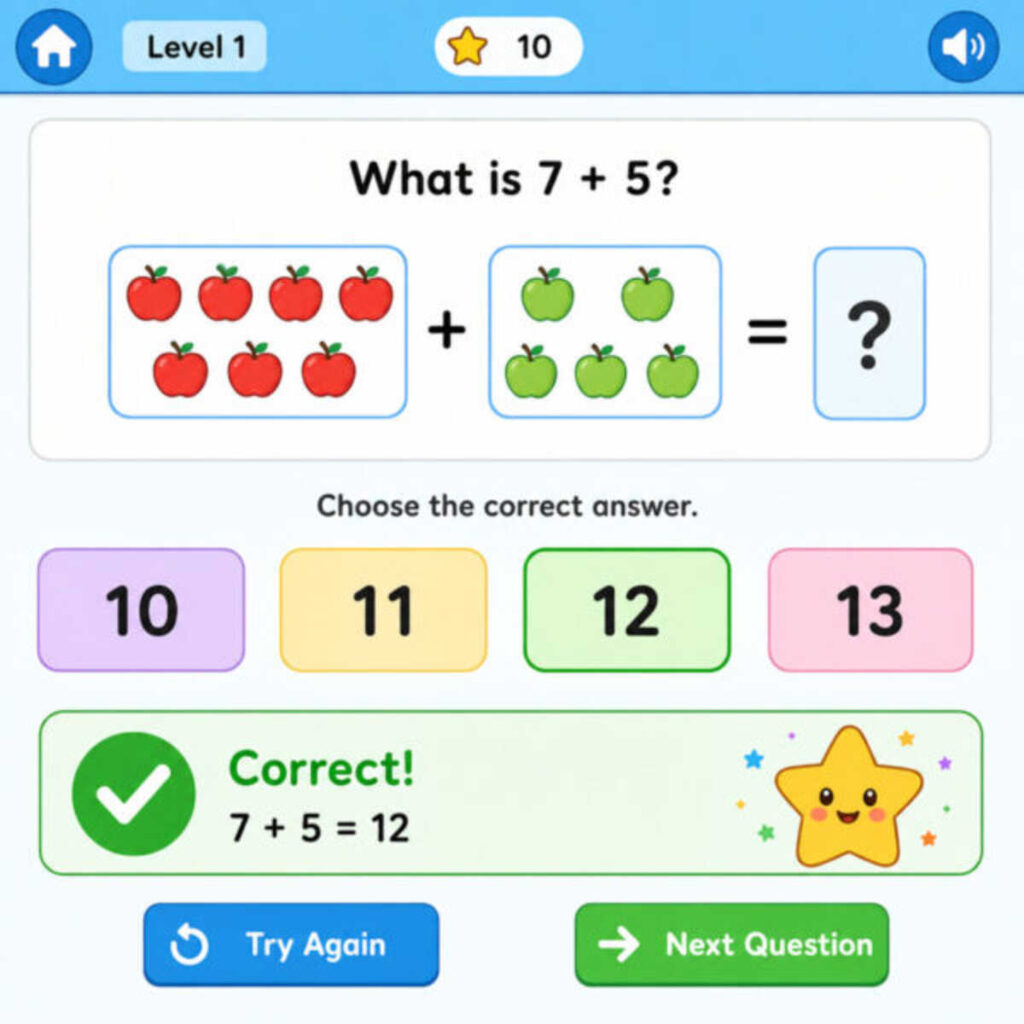
Feedback completes the loop. Children need to see the result of their actions soon enough to adjust. In a board game, feedback might be moving forward, earning a clue, or turning over a self-checking card. In a movement game, it might be reaching the right zone or hearing a peer explain why a choice fits. In a digital game, it might be a sound, an animation, a prompt, or a visual correction.
Good feedback is specific, not just cheerful. “Try again” is less useful than “Check the tens column” or “Look for the word that has the same ending sound.” A child who knows what to adjust is more likely to stay with the challenge.
Competition should be used with care
Competition can energise a classroom, but it can also narrow participation if the same children always win. In primary game design, competition works best when it is balanced with cooperation, self-improvement, and varied ways to succeed. A child who is not the fastest reader or calculator should still be able to contribute through strategy, explanation, creativity, memory, leadership, or careful observation.
One simple shift is to make children compete against the game rather than against each other. The group might try to solve five puzzles before the timer ends, protect a shared resource, or unlock a final clue through teamwork. This keeps urgency without turning classmates into obstacles.
Another option is to reward improvement. Children can try to beat their previous score, complete a harder route than last time, or explain one more answer than before. This approach supports confidence because progress is personal.
If you do use player-versus-player competition, keep rounds short and rotate roles. Avoid public elimination, long waiting times, or winner-takes-all scoring. The aim is not to remove excitement; it is to make sure excitement includes more children.
Healthier alternatives to winner-takes-all play
- Team missions: Everyone contributes to one shared goal.
- Cooperative puzzles: Children need different clues or roles to complete the task.
- Personal best rounds: Children measure growth against their own previous performance.
- Rotating expert roles: Different children lead in reading, drawing, calculating, timing, or explaining.
- Mystery outcomes: Children collect information throughout the game and solve a final challenge together.
- Choice-based scoring: Points can be earned for accuracy, explanation, collaboration, and creative problem-solving.
These formats maintain energy while reducing pressure. They also align more closely with the social learning that often happens in primary classrooms.
Digital, physical, and blended games all have a place
A primary game can be digital, physical, or blended. Each format has strengths, and the best choice depends on the learning goal, the children’s ages, the available resources, and the setting. The format should serve the experience, not dominate it.
Physical games are often excellent for young learners because they involve touch, movement, and face-to-face interaction. Children can hold cards, build models, move around the room, sort objects, and talk through their thinking. These actions make abstract ideas feel more concrete.
Digital games can offer instant feedback, adaptive difficulty, audio support, animation, and independent practice. They can be especially useful when children need repeated attempts, immediate correction, or visual simulations that would be difficult to create physically. However, digital design still needs clear learning intent. A flashy screen does not guarantee meaningful engagement.
Blended games combine both approaches. For example, children might use physical clue cards but enter answers on a shared screen. They might complete a classroom treasure hunt and then use a tablet to record evidence. They might build a shape with blocks, photograph it, and explain their reasoning in a digital portfolio.
A note on technical setup
If adults are testing a digital activity, the learning experience can be affected by the setup. A teacher or designer might even search for “second monitor frame droping while in game on primary” when a game runs smoothly on one display but stutters on another. That kind of technical issue is not part of child engagement itself, but it can interrupt a lesson if the game is being projected, mirrored, or demonstrated.
For classroom use, test the game in the same conditions children will experience. Check the display, sound, internet connection, login process, screen visibility, and any touch or keyboard controls before the lesson begins. The smoother the setup, the more attention children can give to the challenge rather than the technology.
Visual design should guide attention, not overwhelm it
Children are naturally drawn to colour, movement, characters, and sound, but more stimulation is not always better. Good visual design helps children understand what matters. It should guide attention toward the task, the next action, and the feedback.
For physical games, this might mean using large readable cards, clear icons, consistent colours, and uncluttered boards. For digital games, it might mean limiting distracting animations, making buttons easy to identify, and keeping instructions visible at the point of use. Children should not have to hunt for the next step.
Visual hierarchy is especially important for primary-aged learners. If everything is bright, moving, or shouting for attention, nothing stands out. Use contrast deliberately. Highlight the active choice, the current score, the next clue, or the feedback message. Keep decorative elements away from key information.
Sound should also be purposeful. A short audio cue can confirm a choice or mark progress, but constant noise can make it harder for children to think or hear each other. If the game will be used in a classroom, include a way to lower or mute sound without losing essential feedback.
Language and instructions need special care
A primary game can fail before it begins if the instructions are too long, too abstract, or too dependent on adult explanation. Children need language they can process quickly. This does not mean talking down to them; it means making the rules concrete and visible.
Use short sentences for instructions. Break actions into steps. Demonstrate a sample turn before expecting children to play independently. If possible, keep a visual reminder nearby: “Pick a card. Read it. Solve it. Move your counter. Explain your answer.”
The vocabulary in the game should align with the learning goal. If children are learning new subject words, then those words should appear in meaningful contexts. If the aim is not vocabulary development, avoid unnecessary complex wording that creates barriers.
For multilingual learners, visuals, gestures, partner talk, and modelled examples can support access. Games can be especially helpful because they show meaning through action, but only when the rules are transparent. A child who understands the game flow can often participate while still developing language confidence.
Inclusion is part of the design, not a final check
Inclusive primary game design asks who can participate, who might be left out, and what adjustments can make the experience better for everyone. Inclusion is not only about ability. It also includes language, culture, confidence, sensory needs, mobility, attention, prior knowledge, and social dynamics.
Start by looking at the required actions. Does the game depend heavily on reading speed? Fine motor control? Loud speaking? Fast movement? Competitive confidence? If so, consider whether those demands are essential to the learning goal. If they are not essential, offer alternatives.
For example, a spelling game may require word knowledge but not necessarily handwriting speed. Children could build words with letter tiles, choose from options, say the word aloud, or type it. A science game may require classification but not public performance. Children could sort privately first, then share in pairs.
Representation also matters. Characters, examples, names, settings, and images should feel welcoming and varied. Children notice who appears in stories and who is absent. A primary game does not need to carry a heavy message to be inclusive; it simply needs to avoid narrow assumptions about families, interests, abilities, and experiences.
Inclusion checklist for primary game design
- Can children understand the goal without relying only on written instructions?
- Are there ways to participate without being the fastest, loudest, or most confident player?
- Can children use speech, drawing, movement, objects, or writing where appropriate?
- Are visuals clear, readable, and not overly cluttered?
- Are cultural references accessible rather than dependent on one narrow experience?
- Can the game be adjusted for children who need more time or reduced sensory input?
- Does the scoring system reward more than one kind of strength?
- Are mistakes treated as part of learning rather than as public failure?
Building with these questions from the start usually improves the game for everyone, not only for children with identified needs.
Classroom management improves when the game structure is clear
Even a well-designed game needs a clear routine. Children may become excited, and excitement can turn into noise or confusion if expectations are vague. The aim is not to make play rigid. The aim is to create enough structure that children can play successfully.
Before the game begins, explain the goal, model one turn, assign roles if needed, and clarify what to do when children get stuck. Keep materials organised so children do not spend valuable time searching for missing pieces. If the game involves movement, define the space and the signal to stop.
Roles can be especially helpful. A group might have a reader, mover, checker, encourager, recorder, or materials manager. Roles reduce arguments because children know what they are responsible for. They also help quieter children participate in a defined way.
After the game, build in a short reflection. Ask children what strategy helped, what they found difficult, what they noticed, or what they would try next time. Reflection turns play into learning memory. Without it, children may remember the excitement but miss the concept.
Home play can strengthen confidence without feeling like homework
Families often want to support learning at home but do not want every evening to feel like a formal lesson. A primary game can help by creating a relaxed structure for practice. The key is to keep it short, positive, and easy to repeat.
Home games do not need special equipment. A deck of cards can support number bonds, comparing quantities, memory games, and quick mental maths. Sticky notes can become word hunts, sentence builders, or sorting activities. Household objects can support counting, measuring, describing materials, classifying shapes, or storytelling.
Parents and carers can also adapt familiar games. A simple board game can include question cards. A scavenger hunt can focus on adjectives, shapes, sounds, or science observations. A storytelling game can begin with three random objects from the kitchen table.
The best home learning games protect the relationship first. If a child is tired, frustrated, or resistant, shorten the game or make it cooperative. Ten focused minutes with laughter and encouragement is usually more valuable than a long session filled with pressure.
Easy home game ideas
- Number snap: Turn over cards and call out whether the total is odd, even, more than ten, or part of a target number bond.
- Word detective: Search for words around the home that contain a target sound, spelling pattern, prefix, or suffix.
- Object sort: Sort household items by material, shape, size, texture, use, or whether they are natural or made.
- Story bag: Put three objects in a bag and create a story that includes all of them.
- Question path: Place cards on the floor as stepping stones. Each correct answer moves the child along the path.
- Build and explain: Use blocks, coins, pasta, or toys to model a maths idea, then ask the child to explain how it works.
These activities are simple, but they work because they invite action and conversation. They also show children that learning is not limited to school materials.
Testing a game with children reveals what adults miss
Adults often design games based on how they expect children to behave. Then the first playtest reveals the truth. Children may ignore a rule, find an unintended shortcut, misunderstand the goal, focus on a decorative detail, argue over turns, or become fascinated by a part of the game the adult considered minor.
This is not failure. It is valuable design information. A primary game improves when adults observe real play and adjust. The most useful question is not “Did the children like it?” but “What did the game make them do?” If it made them discuss, reason, practise, revise, and stay engaged, the design is working. If it made them wait, copy, guess randomly, or focus only on winning, it needs refinement.
When playtesting, watch for friction points. Where do children stop and ask for help? Which rule causes disagreement? Which children are left behind? Which part creates genuine excitement? Which part creates noise without learning? Small changes can make a large difference.
What to observe during a playtest
- How quickly children understand the goal
- Whether the rules can be remembered after one demonstration
- How often children practise the target skill
- Whether feedback helps them improve
- Which children participate most and least
- Whether waiting time is too long
- Whether the challenge is too easy, too hard, or uneven
- How children respond to mistakes
- Whether the ending feels satisfying
- What children say the game is “about” afterward
Children’s comments can be revealing, but their behaviour tells an even deeper story. A game that looks fun for two minutes but does not sustain useful thinking may need more meaningful choices or a clearer challenge.
Common mistakes in primary game design
Many primary game problems come from good intentions. Adults want the experience to be exciting, so they add more rules, rewards, visuals, or content. Unfortunately, more can make the game harder to play and less effective.
One common mistake is trying to teach too much at once. A game that covers spelling, grammar, punctuation, handwriting, teamwork, speed, and creativity may overwhelm children. Focus creates better play. You can always create a series of games or add extension rounds later.
Another mistake is relying too heavily on luck. Chance can make games exciting and fairer for mixed abilities, but if luck controls everything, children may not practise the intended skill. A dice roll can decide how far a child moves, but their reasoning, answer, or strategy should still matter.
A third mistake is making the game too adult-led. If the teacher must approve every move, children spend too much time waiting. Build in peer checking, answer cards, examples, or self-correcting materials where possible. The adult can then observe and support rather than control every second.
Design traps to avoid
- Adding a theme that does not connect to the learning task
- Writing rules that require repeated adult explanation
- Rewarding only speed when accuracy or reasoning matters more
- Making children wait too long between turns
- Using public failure as a consequence
- Creating one pathway that suits confident readers but not others
- Letting visuals distract from the actual task
- Ending the game without reflection or consolidation
- Assuming digital automatically means engaging
- Measuring success only by noise, laughter, or excitement
Avoiding these traps does not make a game dull. It makes the fun more purposeful and the learning easier to see.
Search intent matters when people look for a primary game
The phrase “primary game” can mean different things to different people. A teacher may be searching for a classroom activity for primary school pupils. A parent may want a learning game for home practice. A designer may be researching child-centred mechanics. Someone typing “primary the game” may even be looking for a specific title, a phrase they half-remember, or a general game connected with primary learning.
This variety matters because good content and good design both begin with user intent. If you are creating a resource, be clear about who it is for and what problem it solves. A primary game for phonics intervention should be described differently from a primary game for whole-class science review. A digital game for independent practice needs different instructions from a cooperative playground game.
The same principle applies inside the game itself. Children also have intent. They want to know what they are doing, how to succeed, whether the activity feels fair, and why it is worth their attention. When the design answers those questions quickly, engagement becomes much easier.
Measuring success beyond “the children enjoyed it”
Enjoyment matters, but it is not the only measure of success. A primary game should be enjoyable and useful. To evaluate it effectively, consider engagement, learning behaviour, confidence, independence, and transfer.
Engagement can be observed through attention, participation, persistence, and talk. Are children staying with the task? Are they discussing the right ideas? Are they trying again after mistakes? Learning behaviour can be seen in the quality of answers, explanations, strategies, and corrections.
Confidence is also important. Some children may not master the skill immediately, but they may become more willing to attempt it. That willingness is valuable because confidence often opens the door to further practice.
Transfer is the strongest sign that the game has supported learning. Can children use the skill outside the game? Can they explain the concept in a different task? Can they recognise the pattern later in a book, problem, experiment, or conversation? If the answer is yes, the game has done more than entertain.
Useful reflection questions for adults
- What did children practise most often during the game?
- Did the game create the type of thinking I intended?
- Which children were most engaged, and why?
- Which children needed more support?
- Did feedback help children improve during play?
- Did children use the target vocabulary or strategy afterward?
- What rule, material, or prompt should be simplified next time?
- What extension would deepen the challenge for ready learners?
These questions keep improvement practical. You do not need a perfect game on the first attempt. You need a design that can be observed, adjusted, and strengthened.
Practical examples of primary game mechanics
Game mechanics are the actions that drive play. Choosing the right mechanic helps align the fun with the learning. The same topic can feel very different depending on whether children are matching, racing, building, explaining, collecting, sorting, or solving.
For recall and fluency, matching games, quick draws, bingo-style boards, and card flips can work well. For reasoning, use mystery clues, “which one does not belong” challenges, ranking tasks, or strategy choices. For creativity, use story prompts, design missions, role-play cards, or build-and-explain activities. For collaboration, use shared puzzles, hidden information, group roles, or team resource management.
The mechanic should make the desired thinking unavoidable. If you want children to explain, the game must require explanation before progress. If you want children to compare, the game should present options that invite comparison. If you want children to revise, include feedback that makes revision meaningful.
Matching mechanics to learning goals
- Recall: card pairs, bingo grids, quick response rounds, memory trails
- Classification: sorting mats, category races, odd-one-out sets, concept maps
- Reasoning: mystery clues, proof cards, debate corners, strategy paths
- Vocabulary: clue giving, word building, definition swaps, sentence challenges
- Number fluency: dice combinations, target totals, card calculations, path games
- Science enquiry: prediction cards, observation hunts, variable changes, evidence sorting
- Writing confidence: story dice, character missions, sentence builders, editing quests
- Collaboration: shared missions, role cards, team puzzles, group construction challenges
This kind of matching keeps the game from becoming a worksheet in disguise. The play action and the learning action become one and the same.
Keeping games fresh without redesigning everything
Once a primary game works, you do not need to start from scratch every time. Children often enjoy familiar structures because they can focus on the new content instead of relearning rules. A reusable game frame can support many lessons.
For example, a “collect the clues” structure can be used for reading comprehension, science vocabulary, history facts, or maths reasoning. A “build the path” structure can support phonics, number bonds, grammar, or classification. A “rescue mission” structure can become a geography challenge one week and a spelling challenge the next.
The trick is to keep the rules stable while changing the content and challenge. This saves preparation time and helps children become more independent. It also allows the adult to refine one strong format rather than manage many weak ones.
You can refresh a familiar game by adding a new role, changing the win condition, introducing harder cards, adding a cooperative twist, or asking children to create new prompts. When children help design the next round, they often show a deeper understanding of the content.
Children can become game designers too
One of the most engaging ways to use primary game design is to let children design games themselves. This shifts them from players to creators. They must think about rules, fairness, challenge, audience, instructions, and feedback. In doing so, they practise communication, planning, testing, and revision.
Start small. Ask children to change one rule in an existing game and explain what happens. Then invite them to create new question cards, design a board, invent a character mission, or build a challenge for another group. Over time, they can design complete games connected to a topic they have studied.
Child-designed games do not need to be polished to be valuable. The learning comes from the design conversation. Why is this rule fair? How will players know if they are correct? What happens if someone gets stuck? Is the game too easy or too hard? What should players learn by the end?
This process also builds empathy. Children begin to think about the player’s experience, not only their own ideas. That is a powerful skill, and it reaches far beyond games.
A balanced approach creates lasting engagement
Engaging children through primary game design is not about making every lesson loud, fast, or competitive. It is about using play to create attention, action, feedback, and meaning. When the design is clear, children can take risks, practise more willingly, and connect learning with positive emotion.
The most useful primary game is one that children understand quickly, want to continue, and learn from while playing. It has a focused purpose, accessible rules, meaningful choices, and a structure that supports different learners. It also leaves room for reflection, because the best learning games do not end when the pieces are packed away.
If you are creating or choosing a game, begin with the learning goal, then design the play around it. Keep the rules simple, test with real children, observe what the game makes them do, and refine from there. With thoughtful design, a primary game can become much more than a fun activity; it can be a practical path to confidence, curiosity, and deeper understanding.